
RESEARCH & INSIGHTS
A policy briefing for Michigan behavioral health providers and limited-license practitioners
Celeriti Practice Management | Staff | June 2026
Blue Cross Blue Shield of Michigan announced changes to its incident-to billing policy this month, significantly impacting how behavioral health practices are staffed and paid. Incident-to billing allows a lower-licensed or unenrolled provider to bill under a supervising provider’s NPI, reimbursed at the supervising provider’s rate. Practices have relied on this for years to employ clinicians who cannot yet enroll directly with BCBSM, particularly in behavioral health, where the supervision model has shaped how practices grow their staff.
The changes take effect in two phases. Starting September 1, 2026, all incident-to claims must carry the SA modifier and will no longer earn value-based reimbursement (VBR), a performance-based increase to the standard fee schedule available to providers who participate directly in BCBSM’s Physician Group Incentive Program. Starting March 1, 2027, providers eligible for direct participation with BCBSM, including NPs, PAs, and most limited license practitioners, can no longer bill incident-to.
For fully licensed nurse practitioners and physician assistants, the path forward is straightforward: enroll directly, bill directly, stay eligible for incentive programs. For most limited-license behavioral health practitioners, there is no equivalent path.
Limited License Counselors (LLCs), Limited License Master Social Workers (LLMSWs), Limited License Marriage and Family Therapists (LLMFTs), and Temporary Limited License Psychologists (TLLPs) cannot enroll directly with BCBSM. Provisional licensure is a required, time-bound step toward full, independent practice in each of these disciplines.
Reaching full licensure means logging thousands of hours of supervised clinical work, typically over a period of years. LLMSWs alone need 4,000 hours over at least two years, earned under supervision in a clinical setting. For most of Michigan’s provisional-license workforce, that setting has been private practice, viable because incident-to billing made the position affordable for the practice.
Removing this mechanism doesn’t just affect the practice and the clinician. It affects patients, since the licensing requirement doesn’t change with BCBSM policy. A newly graduated clinician still needs those hours, and will now likely have to find them in facility-based settings that are already understaffed and oversubscribed. Some will find a spot. Others will wait. Some will leave Michigan for a state where the path is still open.
BCBSM did preserve a conditional incident-to allowance for several other provider types: registered nurses, dieticians, physical therapy assistants, occupational therapy assistants, behavioral health technologists, and community health workers, provided the setting is approved, the work is within scope of practice, and the supervising provider is Michigan-recognized, BCBSM-enrolled, and meeting CMS general supervision requirements. LLCs, LLMSWs, LLMFTs, and TLLPs are not on that list. After February 28, 2027, they cannot bill incident-to in a professional setting under any circumstances.
Further, a narrow, temporary exception exists for two specific transitions: a license moving from another state to Michigan, or a provider moving between BCBSM-participating practices. Both can bill incident-to for up to 90 days at 80% reimbursement with no VBR, provided general supervision requirements are met. After 90 days, direct billing is required. This exists only to smooth a transition already in progress, and it does not apply to LLCs, LLMSWs, LLMFTs, or TLLPs, who have no direct enrollment pathway to transition into in the first place.
LLPs are the real exception. The naming convention makes this easy to misinterpret, but an LLP holds a credential that already allows independent practice in Michigan. LLPs currently billing incident-to under supervision lose that ability on March 1, 2027, like everyone else, but they have somewhere to go: LLPs can credential directly with BCBSM and bill under their own NPI.
That path does have a limit. LLPs who credential directly are not eligible for Medicare Plus Blue PPO or BCN Advantage. Direct credentialing solves the commercial billing problem, not the Medicare Advantage one, and practices need to account for that gap when they plan.
While the policy landscape remains uncertain, practices can take concrete steps now to support their patients and protect their operations.
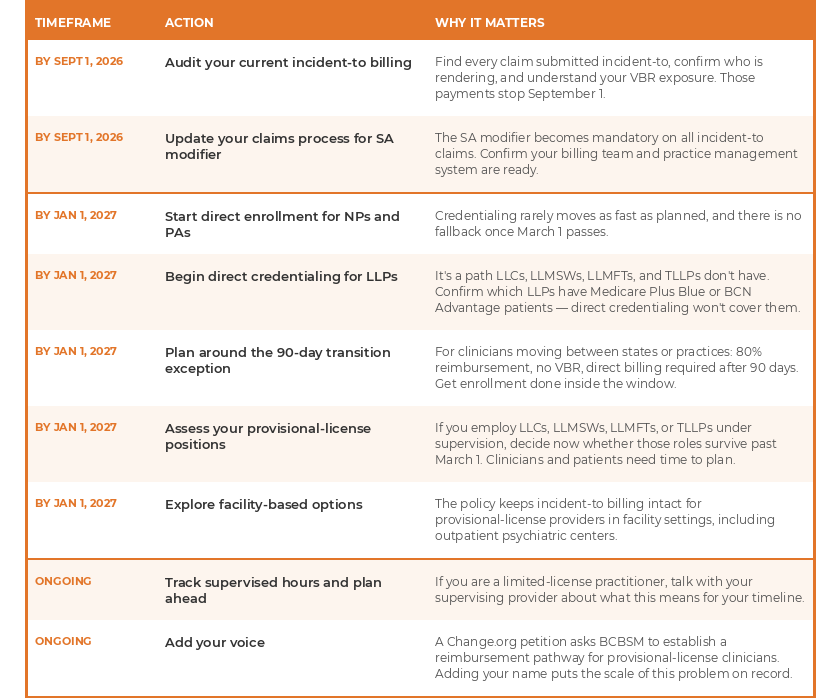
BCBSM has committed to a provider FAQ and updated manual guidance before September. Watch BCBSM’s The Record and BCN Provider News for that detail.
Whether the policy itself changes before March 2027 is an open question. The response from providers has been fast, public, and in clear opposition, but BCBSM has given no indication it intends to revise course. Acting now, before that question is answered, is the only position that leaves your practice with options.
Questions about how these changes affect your practice?
Blue Cross Blue Shield of Michigan, “Changes are coming to incident-to billing policy for Blue Cross, BCN commercial,” The Record, June 2026.
Blue Cross Blue Shield of Michigan, Reimbursement Policy: Incident-to Services and Billing – Professional, effective September 1, 2026 (Phase I) and March 1, 2027 (Phase II).
Michigan Department of Licensing and Regulatory Affairs, Bureau of Professional Licensing, Social Work Licensing Guide.
Michigan State Medical Society, “BCBSM Announces Changes to Incident-to Billing Policy,” msms.org.
WWMT News, “Mental health providers warn BCBSM billing changes could disrupt care for hundreds,” June 2026.
ClickOnDetroit, “‘Devastating’: Michigan mental health care workers concerned BCBSM billing change could cut access to counselors,” June 8, 2026.
Change.org, “Stop BCBSM from limiting access to mental health care,” petition, June 2026.
This article is based on a survey of 80 behavioral health practices conducted February 2–13, 2026, by Celeriti Practice Management. For methodology and full results, contact Celeriti.